
Building a house in Ghana is one of the biggest financial decisions you will make. Whether you are a Ghanaian in the diaspora planning to build back home, a first-time owner in Accra, or an investor developing property across Greater Accra, the cost picture in 2025 looks very different from what it did three years ago. Inflation has eased, the cedi has stabilised, and construction cost inflation dropped to 9.7% by September 2025 — the lowest in years — but input costs remain high and contractors who quote low often make it up later.
This guide is built from current market data, quantity-surveyor estimates, and the on-the-ground experience of the Eli Kalel design-and-build team in Accra. It will walk you through every cost stage: land, drawings, permits, construction, finishes, and the hidden expenses most guides forget to mention.
What Is the Average Cost to Build a House in Ghana in 2025?
As of 2025, the average cost to build a standard 3-bedroom house in Ghana ranges from GH₵650,000 to GH₵1,200,000 (approximately $55,000–$100,000 USD) for the structure alone, excluding land. In Accra, that range shifts upward. A quantity surveyor estimate for a 138 m² 3-bedroom single-storey home in Accra places the total construction and finishing cost at around GH₵314,000–GH₵420,000 for a basic-to-mid finish — but mid-to-high quality finishes push totals toward GH₵700,000–GH₵1,200,000 or higher. Construction costs in Kumasi and regional capitals are typically 8–10% lower than Accra.
For multi-unit or high-rise residential development, AECOM’s 2024 Africa Cost Guide places Accra’s average construction cost at over $2,100 per square metre — one of the higher figures in sub-Saharan Africa, reflecting the cost of imported materials, skilled labour shortages, and logistics overhead.
Cost Per Square Metre in Ghana (2025)
Construction costs in Ghana are best understood per square metre of built area. Current rates:
- Basic / Economy finish: GH₵2,000–GH₵3,200 per m²
- Standard / Mid-range finish: GH₵3,200–GH₵4,800 per m²
- High quality / Luxury finish: GH₵5,000–GH₵8,000+ per m²
A 150 m² 3-bedroom house at mid-range finish therefore costs roughly GH₵480,000–GH₵720,000 for construction alone, before land, fees, or external works. These figures apply to Accra. Remote or peri-urban sites add logistics costs and may require water and electricity connection fees not included above.
The Full Cost Breakdown: Stage by Stage
1. Land Acquisition
Land in Accra varies dramatically. As a rough guide in 2025:
- Prime areas (East Legon, Cantonments, Airport Residential): GH₵500,000–GH₵3,000,000+ per plot depending on size and documentation
- Mid-range areas (Adenta, Ashale Botwe, Dome, Oyarifa): GH₵80,000–GH₵300,000
- Peri-urban corridors (Oyibi, Pokuase, Kasoa): GH₵30,000–GH₵120,000
Always engage a licensed surveyor and conduct a full Land Commission search before paying any amount. Land disputes and title defects are the single most common cause of construction delays and financial loss in Ghana.
2. Architectural and Structural Drawings
Professional architectural drawings and structural engineering designs for a residential project typically cost GH₵8,000–GH₵30,000, depending on size and complexity. These are not optional — the Accra Metropolitan Assembly requires four copies of architectural drawings signed by a certified architect and four copies of structural drawings signed by an engineer before issuing a building permit. Skipping this step means no legal permit, and no legal permit means risk of demolition.
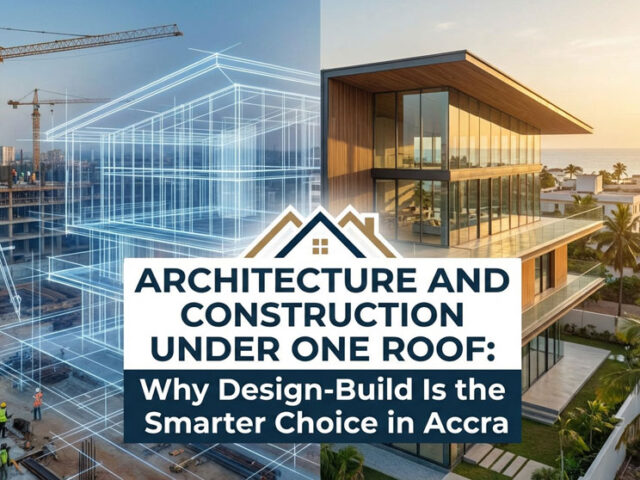
At Eli Kalel, our architectural and structural design services are integrated under one roof. You brief us once; we produce everything needed for permit submission alongside the construction drawings that guide the build. This eliminates the delays that occur when an architect finishes drawings and hands them to a separate contractor who interprets them differently.
3. Building Permit
The building permit fee in Ghana is calculated at 1.1% of the estimated construction cost, payable to the Accra Metropolitan Assembly (or the relevant MMDA for your area). Additional costs include vetting fees, site inspection fees, and processing charges at each stage of the application. Total permit cost for a standard 3-bedroom home in Accra generally falls in the range of GH₵5,000–GH₵15,000.
A valid permit is issued for five years. Online applications are available in Accra and Tema through the AMA portal, which reduces friction and processing time. The full permit process takes anywhere from a few weeks to three months, depending on documentation completeness and the assembly’s workload.
4. Substructure (Foundation)
Foundation costs depend heavily on soil conditions. A standard strip foundation for a 3-bedroom single-storey home in Accra accounts for roughly 15–20% of the total structural budget. Where soil is poor or the site sits near drainage areas, deeper or wider foundation systems are required — this is where a certified soil test report (required for permits) genuinely protects your investment.
5. Superstructure (Walls, Columns, Beams, Slabs)
This is typically the largest single cost item, representing 35–45% of the total build cost. Concrete block construction remains the dominant residential method in Ghana. Costs are driven by cement (imported or locally produced), reinforcement steel, and skilled masonry labour. All three have seen significant price inflation over 2023–2024, though the trend has stabilised in 2025.
6. Roofing
Roofing accounts for roughly 10–15% of total construction cost for a standard residential home. Aluminium long-span roofing sheets remain popular for economy builds; clay or concrete tiles are used in higher-specification homes. Timber roof trusses have largely given way to steel trusses in Accra due to the risk of termite damage and improved local fabrication capacity.
7. Finishes (Plastering, Tiling, Painting, Doors, Windows)
Finishes account for 25–40% of total budget and are where most projects exceed original budgets. Imported Italian tiles, hardwood doors, and aluminium window systems can quickly consume more than the structural budget of a modest home. Common areas where costs spike unexpectedly:
- Kitchen and bathroom fittings (imported sanitary ware)
- Ceiling and cornice work
- External compound wall, driveway, and drainage
- Electrical and plumbing fittings
8. Mechanical, Electrical, and Plumbing (MEP)
MEP services — water supply, drainage, electrical wiring, lighting, air conditioning provision — typically add GH₵30,000–GH₵80,000 for a standard 3-bedroom home, depending on the specification. Air conditioning pre-provision (conduit runs, brackets, electrical circuits) is increasingly standard in Accra builds; installation of actual units is a client responsibility at handover but must be planned for in the build.
Hidden Costs Most Contractors Won’t Mention
Beyond the stages above, here are ten costs that consistently surprise first-time builders:
- Site clearing and levelling — varies widely by terrain; budgeted separately from construction
- Borehole drilling — GH₵12,000–GH₵25,000 if mains water access is unreliable
- Perimeter wall and gate — GH₵30,000–GH₵80,000 depending on length and finish
- Compound drainage — essential in Accra’s rainy season; often omitted from contractor quotes
- Land guard / security costs during construction in some areas
- Generator or inverter provision
- Septic tank if mains sewerage is unavailable
- Water and electricity connection fees from GWCL and ECG
- Completion certificate for habitation — required by law before occupying a building; obtained from the MMDA after a final inspection
- Price escalation contingency — add 15–20% to all budgets for material price movement during construction
Build vs. Buy in Accra: The 2025 Calculation
Buying a completed 3-bedroom apartment in prime Accra costs $250,000–$400,000 USD for luxury units, or $83,000–$150,000 for emerging-area developments. Building on your own land in mid-range areas like Adenta or Ashale Botwe can produce the same quality home for $60,000–$90,000 USD in construction costs — a significant difference. However, building requires time (typically 12–24 months from permit to handover), active management, and sound contractor selection. For diaspora clients who cannot be present, working with an integrated design-and-build firm that manages the full process is the safest approach.
How to Control Your Building Budget
Seven principles that experienced builders in Ghana follow:
- Fix your brief before engaging an architect. Changes after construction begins are the most expensive thing you can do on a building project.
- Get a Bill of Quantities (BOQ) prepared by a quantity surveyor before awarding any contract. This gives you a line-by-line cost basis and a clear scope for contractors to price against.
- Never pay more than 20–30% upfront to any contractor. Reputable firms stage payment against certified work completed.
- Specify materials in writing in the contract. “Good quality tiles” is not a specification. “Porcelain floor tile, minimum 600x600mm, from an approved manufacturer, supplied with purchase receipt” is.
- Hire a clerk of works or project manager if you cannot be on site daily, especially for the structural phase.
- Use locally produced materials where possible. Imported materials carry cedi/dollar exchange rate risk throughout the build.
- Work with an integrated design-and-build firm. A single firm responsible for both design and construction has aligned incentives: they cannot blame design errors on someone else, and they design to their own construction realities rather than theoretical ideals.
Why the Architect–Contractor Relationship Matters More Than Cost
Many Ghanaian homeowners hire an architect, receive drawings, then send those drawings to three contractors for competitive quotes. The cheapest quote wins. The problem: the cheapest contractor often wins by making assumptions that reduce scope or quality, and the architect who designed the building has no authority over how the contractor builds it. Disputes, delays, and quality shortfalls are almost inevitable in this arrangement.
Eli Kalel operates as a single integrated firm — architecture, interior design, and construction all under one team, one contract, and one point of accountability. We design what we can build, and we build what we designed. This is how Accra’s most delivered residential projects get finished on time and to specification.
Get a Free Construction Estimate for Your Project
Whether you are planning a 3-bedroom family home, a storey building investment property, or a custom luxury residence in Accra, Eli Kalel can provide a detailed preliminary cost estimate based on your site, brief, and finish specification. Call us on 0550 338 661 or use our contact form to book a free initial consultation.