

The conversation around house design in Ghana has changed completely in the last five years. Scroll through any Ghanaian architect’s Instagram or TikTok and you will find a steady stream of sleek box houses, double-volume living rooms, frameless glass façades, cantilevered upper floors, and poolside terraces designed for Accra’s climate and status economy. The appetite for contemporary design in Ghana is real, it is accelerating, and it is being shaped by a generation of homeowners who have lived, studied, or travelled internationally and want a home that reflects that.
But design trends and buildable design are different things. The most important question is not just “what looks good?” but “what works in Ghana’s climate, what the best areas in Accra reward, and what holds or grows its value as a residential investment?” This guide answers all three questions — and shows you what Eli Kalel can design and build for you.
The 5 Dominant Modern House Design Styles in Ghana in 2025
1. The Contemporary Box House
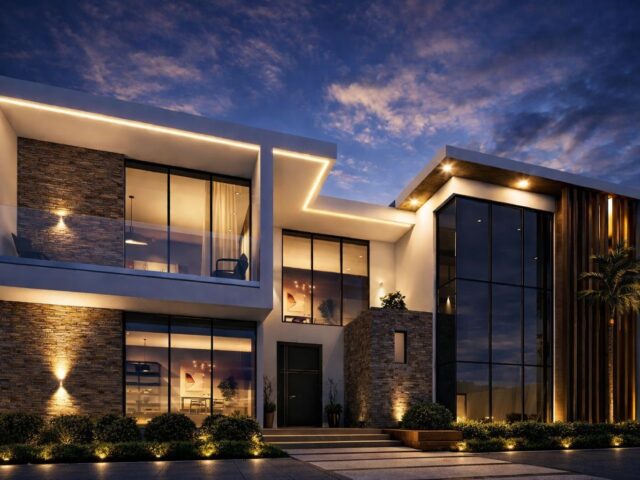
The contemporary box house is without question the most requested residential design style in Accra in 2025. Characterised by clean horizontal and vertical lines, flat or slightly pitched roofs, large rectangular window openings, and smooth rendered exteriors in white, grey, or light earth tones, the box house style communicates status and modernity simultaneously.
The best versions of this style in Accra are not simply European boxes transplanted to tropical conditions. They incorporate deep overhangs to manage solar gain on west-facing façades, shaded terraces and loggias that function as climate buffers between the interior and the harsh midday sun, and raised ground floors with natural ventilation channels beneath the slab. When designed for Ghana rather than copied from a Pinterest board, the box house is genuinely livable, low-maintenance, and commercially strong.
Ideal for: 3 and 4-bedroom homes on plots of 0.5–1 acre in East Legon, Adenta, Ashale Botwe, Oyarifa, and Spintex Road corridors.
2. The Luxury Villa with Indoor-Outdoor Living
For plots with space — particularly in East Legon Hills, Cantonments, Trasacco Valley, and similar premium areas — the luxury villa format continues to dominate the upper end of the Accra residential market. Key design moves include open-plan ground-floor living areas that open directly onto a covered terrace and pool, a double-volume entrance hall or living room, and a master bedroom suite that occupies an entire upper floor wing with its own private terrace.
The Accra climate is fundamentally outdoor-living weather for eight to nine months of the year. Designs that treat the covered outdoor terrace as a primary living space — with full kitchen access, lounge furniture, and shade — produce homes that genuinely respond to how people want to live in Accra, rather than how they think they should live based on European or North American design conventions.
Ideal for: 4–6 bedroom luxury homes for owner-occupation in prime Accra locations, or high-specification rental investment properties targeting the expatriate and executive rental market.
3. The Storey Building / Duplex
Ghana’s residential land constraint has pushed storey buildings into mid-range neighbourhoods that previously favoured bungalow stock. A well-designed storey building on a half or three-quarter plot can yield two income-generating units — a ground-floor 3-bedroom home and a first-floor 3-bedroom apartment — or provide a 4–5 bedroom family home with clearly separated living and sleeping zones on different floors.
The design challenge of storey buildings in Ghana is the staircase: getting vertical circulation to feel generous rather than cramped, and positioning it to borrow natural light rather than create a dark internal spine. The best storey building designs in Accra locate the stair on an external-facing wall with a full-height window or void, turning a functional necessity into a design feature. Eli Kalel’s storey building designs typically pair this with a double-height external feature wall on the street face — creating a façade presence that commands attention and value.
Ideal for: Half-plot to 3/4-acre sites in Adenta, Dome, Ashale Botwe, Oyarifa, Tema, and Spintex. Very strong investment proposition as a two-unit rental property.
4. The Minimalist Bungalow
Not every homeowner wants a storey building. The minimalist bungalow — compact footprint, single storey, clean detailing, and carefully considered spatial flow — is experiencing a genuine design renaissance in Ghana among younger homeowners, particularly for plots in peri-urban growth corridors like Oyibi, Pokuase, and the Accra-Kumasi highway towns.
The key to a minimalist bungalow that feels generous rather than cramped is the plan: open-plan living-dining-kitchen at the centre of the home, with bedrooms peeling off a single-loaded corridor to one side, and a covered terrace extending the living area outwards. A 120–150 m² footprint, well-designed, will feel more spacious than a 200 m² bungalow that wastes space on awkward circulation. This is where architectural skill — not just construction capacity — creates real value.
Ideal for: Emerging areas and satellite towns, first homes, and income-generating investment properties in the affordable residential segment.
5. The Contemporary African Fusion Home
A growing design direction in Accra’s premium residential market integrates contemporary architecture with deliberate references to Ghanaian and pan-African material culture: courtyards inspired by traditional compound houses, locally quarried stone cladding on feature walls, timber brise-soleil screens referencing woven kente geometry, and earthwork colour palettes drawn from Ghanaian laterite and clay. This style is increasingly requested by Ghanaian diaspora clients who want a home that is unmistakably contemporary but also rooted in where it is built.
This is the direction several of Accra’s most distinguished architecture practices — including the internationally recognised work produced from Accra by practices associated with figures like Sir David Adjaye — have been developing for years. At a residential scale accessible to individual homeowners, it represents some of the most interesting and distinctive design work currently being produced in Ghana.
Ideal for: Custom luxury homes where the client wants design uniqueness and cultural resonance, not just status signalling. Particularly strong in Cantonments, Airport Residential, and beachfront locations outside Accra.
3-Bedroom vs 4-Bedroom: What Should You Build in Ghana?
The most commonly built residential home in Ghana is a 3-bedroom house. It is also the most commonly requested rental unit, the most liquid property on resale, and the most attainable for first-time builders. However, in Accra’s prime and mid-range markets in 2025, a 4-bedroom home commands a significant rental premium and resale premium, particularly if it includes an en-suite master bedroom with a walk-in wardrobe, a family lounge separate from the main sitting room, and a minimum of three bathrooms.
The practical guidance from Eli Kalel’s market experience:
- If your plot is under 0.4 acres and your budget is under GH₵600,000 for construction: build a well-designed 3-bedroom to maximise quality on your available footprint.
- If your plot is 0.5 acres or above and your budget allows for 4 bedrooms with full finishes: the 4-bedroom command premium in Accra is worth the additional construction investment in mid-range and prime areas.
- For rental investment: 3-bedroom units let faster. 4-bedroom units command higher monthly rents and attract longer-tenure professional and expatriate tenants.
Design Features That Matter Most for Ghana’s Climate
Ghana sits between 4° and 11° north of the equator. That fact drives a set of non-negotiable design responses that distinguish a house built for Ghana from a house that just happens to be in Ghana:
- Roof overhangs of minimum 600mm on all south and west elevations to shade windows from high sun angles and protect walls from tropical downpours
- Cross-ventilation in all habitable rooms — windows on opposite or adjacent walls to allow through-ventilation and reduce reliance on air conditioning
- Covered outdoor terrace of minimum 15–20 m² — the single most-used room in an Accra house for eight months of the year
- Ceiling heights of minimum 3m in living areas, rising to 3.5–4m in double-volume spaces, to improve convective cooling
- Roof drainage designed for peak Accra rainfall intensity — minimum 150mm gutters with spaced outlets and downpipes sized for 75mm/hour rainfall events
- External walls with adequate thermal mass — 225mm block or equivalent — to moderate diurnal temperature swings
- Tiled floors throughout (not carpet or timber in living areas) — cool to the touch, durable in humidity, low-maintenance
What Neighbourhoods Should You Build In? (Accra, 2025)
Location determines value in Accra more than any other single factor. As of early 2026, the current price and investment landscape:
- Cantonments, Airport Residential, Labone: Prime locations. New builds in these areas sell at $1,500–$2,000+ per sqm. Limited land availability makes these the highest-value locations but also the most expensive to develop. Return on investment is strong for high-specification builds targeting the expatriate and senior professional rental market.
- East Legon, Roman Ridge: Established premium residential. 4-bedroom houses sell in the $450,000–$600,000 range. Strong expatriate rental demand at $2,500–$4,000 per month for well-specified 3–4 bedroom homes.
- Adenta, Ashale Botwe, Oyarifa: The fastest-growing value corridor in Greater Accra. Good road access, improving infrastructure, and significantly lower land costs than the established premium areas. Emerging area developments here are showing 15–20% annual appreciation. The sweet spot for first-time builders and rental investors seeking capital growth over a 5–10 year horizon.
- East Legon Hills, Ogbojo: Development-stage premium, with several gated estates establishing Accra’s newest luxury residential frontier. Early movers here are capturing significant uplift as the area matures.
- Spintex Road: Strong commercial and residential mixed-use corridor. Well-suited to duplex or storey building investment for the professional rental market.
How to Commission a Modern House Design in Ghana
The process with Eli Kalel is designed to be straightforward:
- Initial consultation — we discuss your site, your brief (bedrooms, must-have spaces, lifestyle requirements), your budget, and your timeline. Free of charge, no obligation.
- Site appraisal — we assess your plot for buildability, orientation, access, drainage, and planning constraints.
- Concept design — our architects produce a concept design with floor plans and 3D exterior renders so you can see your home before it is built. Revisions are made until the design reflects your vision.
- Detailed design and permit drawings — we develop the concept to full permit-ready architectural and structural drawing standard and manage the AMA submission.
- Construction — we build it. Weekly site reports, milestone-based payments, and a project manager you can call at any time.
- Handover — keys, documentation, and a 12-month defects liability period.
Whether you are starting from a site or still choosing where to build, we would like to show you what Eli Kalel can design for you. Call us on 0550 338 661 or send us your project brief.